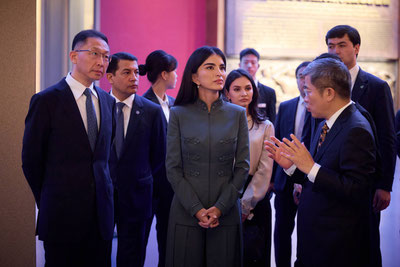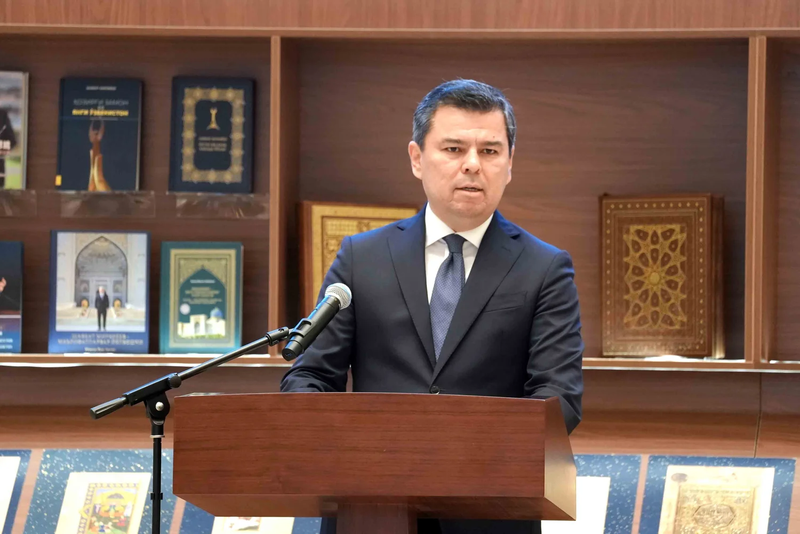
President's press secretary Sherzod Asadov spoke at the international media forum "Islamic Civilization: A New World, New Initiatives" held at the Center of Islamic Civilization in Tashkent.
“Today information knows no boundaries. News about an event reaches millions of people in a matter of seconds. However, along with information, lies, manipulation, fake news, and information attacks are also spreading rapidly. Therefore, one of the most important tasks facing journalism today is to ensure reliable information”, — he said.
Sherzod Asadov also touched upon the rapid penetration of artificial intelligence into journalism. According to him, artificial intelligence does not replace the journalist, but rather expands his capabilities.
"No matter how much technology develops, the main criteria of journalism — truth, impartiality, conscience, and the principles of serving human interests — must remain unchanged”, said the President's press secretary.
He also raised the issue of the crisis of true freedom of speech as one of today's global problems of modern journalism. He noted that in some cases, freedom of speech turning into a tool of political pressure is damaging the impartiality and reliability of journalism.
According to Sh. Asadov, protecting national interests does not mean closing off from the world. On the contrary, it is relying on facts, objectively analyzing events, and establishing open dialogue with society.
The President's press secretary also emphasized that the journalist's task is not limited to delivering information. The journalist listens to people's worries and concerns, raises their problems, and ensures that the voice of the public reaches state institutions.
At the same time, Sherzod Asadov noted that the forum being held at the Center of Islamic Civilization has a special symbolic meaning. This place, established on the initiative of the President, serves to introduce the millennia-old scientific and spiritual heritage of our people to the world.
According to him, the legacy of great scholars such as Khwarizmi, Beruni, Ibn Sina, Imam Bukhari, Imam Termizi, Imam Moturidi, Ulugbek, and Alisher Navoi is the priceless wealth of all humanity. The fact that the name of Khwarizmi lives on today in the term “algorithm” also shows the close connection of our ancestors' heritage with modern science and technology.
Asadov emphasized the need not only to preserve national heritage in museums and books, but to convey it in modern digital formats, in a language understandable to the younger generation, and objectively to the world community.