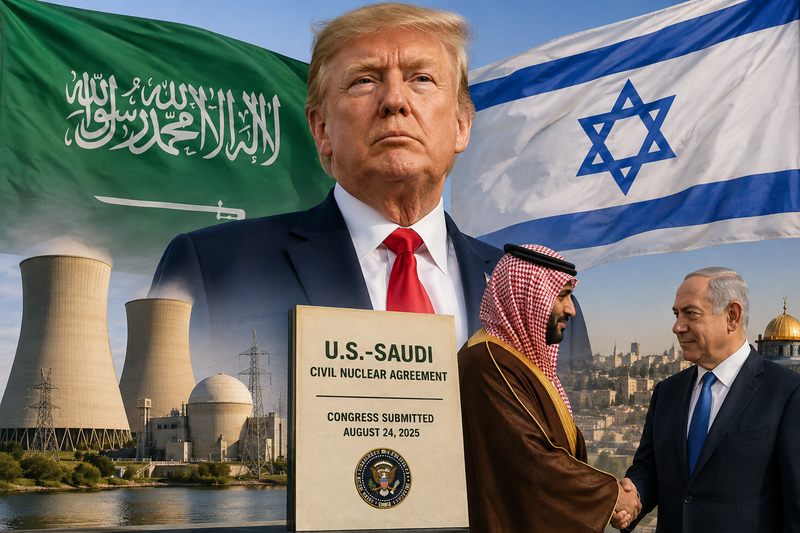
However, for the agreement to enter into force, Riyadh must normalize relations with Israel and recognize it. A U.S. administration official stated this.
It was reported that the document was sent to Congress on August 24. The agreement concluded in July would allow U.S. companies to export civilian nuclear technologies to Saudi Arabia.
“The U.S. President's position has not changed: the agreement will only be implemented if Saudi Arabia joins the Abraham Accords,” said the administration official.
The Abraham Accords were concluded in 2020–2021 through U.S. mediation with the aim of normalizing relations between Israel and the United Arab Emirates, Bahrain, Morocco, and Sudan.
A few days after a nuclear deal with Saudi Arabia was reached in July, Trump made Riyadh's normalization of relations with Israel a condition for the agreement to enter into force. Former President Joe Biden also supported a nuclear deal with Saudi Arabia and tried to link it to the Abraham Accords.
In 2023, diplomats said Saudi Arabia was close to normalizing relations with Israel. However, the situation changed after Israel's war in Gaza began in October of that year. Saudi Arabia now demands that an irreversible process leading to the establishment of a Palestinian state begin before it recognizes Israel.
Under the 30-year nuclear agreement, construction of AP1000 reactors in Saudi Arabia is planned. The project, worth tens of billions of dollars, could bring significant benefits to the U.S. company Westinghouse.
The agreement has been sent to Congress leaders and is expected to be presented to committees on August 26. If Congress does not reject the deal within 90 working days, it will enter into force.
Even if Congress rejects the agreement, Trump can veto the decision. In that case, a two-thirds vote of Congress members is required to override the veto.
Some Democratic lawmakers and advocates of nuclear non-proliferation have criticized the agreement. According to them, the document does not prohibit uranium enrichment and nuclear waste reprocessing in Saudi Arabia. These processes are considered one of the possible ways to create a nuclear weapon.
The U.S. administration, in turn, says that the agreement includes non-proliferation measures required by law.
According to Henry Sokolski, an expert on nuclear non-proliferation policy, the process of submitting the agreement to Congress could also open the door to implementing it without strict conditions regarding normalization with Israel or nuclear non-proliferation.