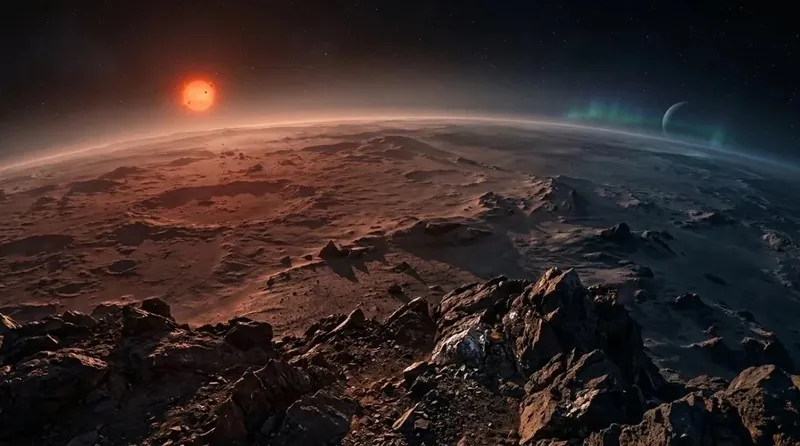
A significant result has been recorded in scientific research on the search for life beyond the Solar System. Scientists have for the first time confirmed through observations the presence of an atmosphere on the exoplanet LHS 1140b, which is Earth-like and located in the habitable zone. This is reported in a study published in the journal Science.
It is noted that this planet is located approximately 49 light-years from Earth, and liquid water may exist on its surface.
Previously, atmospheres were mainly detected on gas giants and "sub-Neptune" type exoplanets. Additionally, signs indicating the presence of an atmosphere were observed on some rocky exoplanets located outside the habitable zone. However, according to scientists, LHS 1140b has ushered in a completely new stage in this regard.
Dr. Collin Cherubim, the lead author of the study who until recently worked at Harvard University, stated that this is the first time the presence of an atmosphere on a rocky planet located in the habitable zone beyond the Solar System has been confirmed by observations.
He emphasized that this result is also significant as the first direct detection of a component in the atmosphere of any rocky exoplanet.
According to Cherubim, this discovery has made LHS 1140b one of the most promising objects for studying astrobiology and habitable environments beyond the Solar System.
It is reported that the mass of LHS 1140b is 5.6 times that of Earth, and its radius is about 70% larger. Although the planet is similar to Earth in overall composition and temperature, it also has a number of important differences. In particular, it is tidally locked to its star, likely has a much higher water content, and its atmosphere may differ significantly from Earth's.
Discovered in 2017, LHS 1140b orbits a small red dwarf star in the constellation Cetus. While this star is smaller and dimmer than the Sun, it emits a large portion of its energy in the form of ionizing radiation.
According to the authors of the study, LHS 1140b possesses the essential factors for habitability. It is a rocky planet, its temperature allows for liquid water, and its atmosphere limits the escape of water into space and protects the surface from harmful radiation. Additionally, its star is relatively quiet, with few strong flares observed.
Scientists reported that no atmosphere was detected on another rocky planet in the same system, LHS 1140c.
As part of the study, observations were conducted when LHS 1140b transited its star, using an infrared spectrograph installed on the Magellan Clay telescope at the Las Campanas Observatory in Chile. Data collected in 2024 recorded helium gas escaping from the planet into space.
Cherubim stated that the researchers also checked all potential factors, such as the influence of Earth's atmosphere. Although helium was not detected again in observations conducted in 2025, scientists reanalyzed the initial results and ruled out the possibility of false positives.
Professor Jane Birkby of Astrophysics at the University of Oxford assessed this result as a significant scientific achievement. She noted that red dwarf stars are the most common stars in the universe, and rocky planets located in their habitable zones are the most promising targets for searching for life. However, the high activity of such stars could destroy planetary atmospheres.
According to the professor, the confirmation of an atmosphere around LHS 1140b is an important step in understanding what conditions for life might be like in red dwarf star systems. Furthermore, the fact that the atmospheric signal varies over time is also of great interest to scientists.
Birkby noted that this situation will help understand how an exoplanet's atmosphere responds to intense ultraviolet radiation from its star, which in turn will serve to answer questions about the likelihood of life emerging on the planet and what protective mechanisms it might develop.