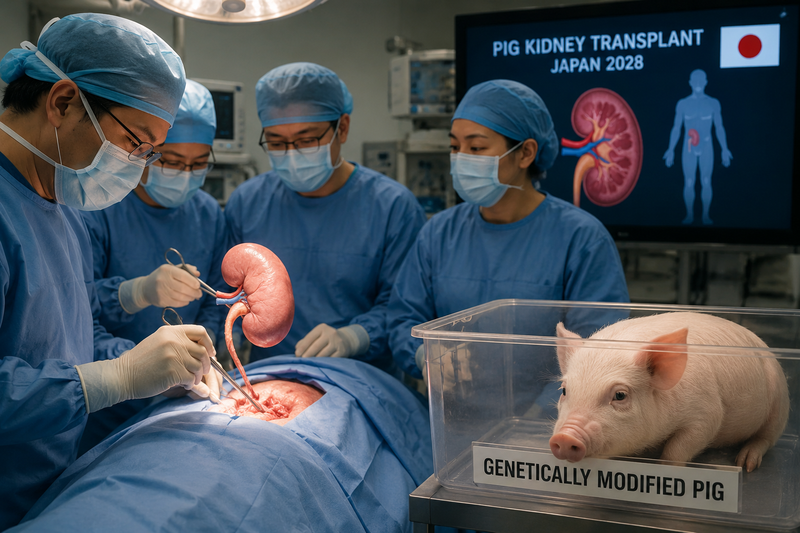
Clinical trials on transplanting kidneys from genetically modified pigs into humans are planned to begin in Japan from 2028. This was reported by The Japan Times.
This project is being implemented by the biotechnological startup PorMedTec, established on the basis of Meiji University. The company is using genetically modified pigs created by the US biotechnological firm eGenesis.
According to the plan, kidneys obtained from pigs will be transplanted to patients at Hokkaido University Hospital in Sapporo and at Shonan Kamakura General Hospital located in Kanagawa Prefecture.
Experts assess the technology of transplanting organs from animals to humans as one of the promising methods to reduce the shortage of donor organs for transplantation.
It has been reported that 69 modifications have been introduced into the genes of pigs bred by eGenesis. This aims to reduce the risk of the human immune system rejecting the transplanted organ, as well as to decrease the likelihood of animal viruses being transmitted to humans.
To date, four clinical trials based on this technology have been conducted in the United States. Some patients did not require dialysis treatment for several months after the surgery.
Currently in Japan, over 300,000 people are undergoing dialysis treatment due to kidney failure. Furthermore, nearly 15,000 patients are waiting for a kidney transplant.
PorMedTec President and Meiji University Professor Hiroshi Nagashima stated that research will continue to ensure that cross-species transplantation becomes an effective medical technology, in the future.
We recall that earlier it was reported that PorMedTec plans to establish a special farm by 2027 to breed cloned pigs for the purpose of transplanting organs into humans. Cloned pigs are animals created as genetically identical copies in a laboratory setting, rather than through natural reproduction.