
Against the backdrop of military escalation in the Middle East, oil prices surged sharply, and disruptions are emerging in global shipping routes. Simultaneously, the U.S. Supreme Court found the tariff policy implemented by President Donald Trump to be unlawful.
Middle East Tensions Impact Energy Markets
The recent military escalation in the Middle East is rapidly impacting international trade. Following strikes by the U.S. and Israel against Iran on February 28, oil and natural gas prices rose sharply.
The international benchmark, Brent crude, rose by up to 13% in early trading on March 2, exceeding $82 per barrel. Market participants expressed concern over potential disruptions to energy supplies via the Persian Gulf.
Nearly 20% of the world's oil trade and a similar portion of liquefied natural gas pass through the crucial maritime chokepoint south of Iran—the Strait of Hormuz. It is currently reported that nearly 150 vessels in this area, including oil and gas tankers, have stopped moving and dropped anchor.
Furthermore, following drone attacks, operations at some Middle Eastern ports were temporarily halted. It was announced that operations were also temporarily suspended at the Jebel Ali port in Dubai, considered one of the world's largest container ports, due to a fire.
Analysts believe this situation could have a noticeable impact on the economies of Europe and Asia, which are particularly reliant on energy imports. If transportation routes remain closed for an extended period, there is a risk of increased global inflation and renewed instability in supply chains.
U.S. Supreme Court Finds Trump Tariffs Unlawful
The U.S. Supreme Court determined that the decision by former President Donald Trump's administration to implement broad import tariffs exceeded presidential authority. The 6-3 ruling quickly impacted political and economic processes.
As a result, a series of measures were announced:
The U.S. administration announced the imposition of a 10% global tariff on all imported goods, based on Section 122 of the 1974 Trade Act. This rate could be increased to 15%.
The European Parliament temporarily suspended negotiations on a trade agreement with the U.S.
Trade talks between the U.S. and India were also postponed to study the consequences of the Supreme Court ruling.
According to reports, over 900 companies have sued the White House over the tariff policy. If they win, the amount the government would have to refund could exceed $160 billion.
U.S. Trade Deficit Reaches Record Level
In 2025, the U.S. goods trade deficit reached $1.24 trillion, marking the highest figure in history. This is 2.1% more than in 2024.
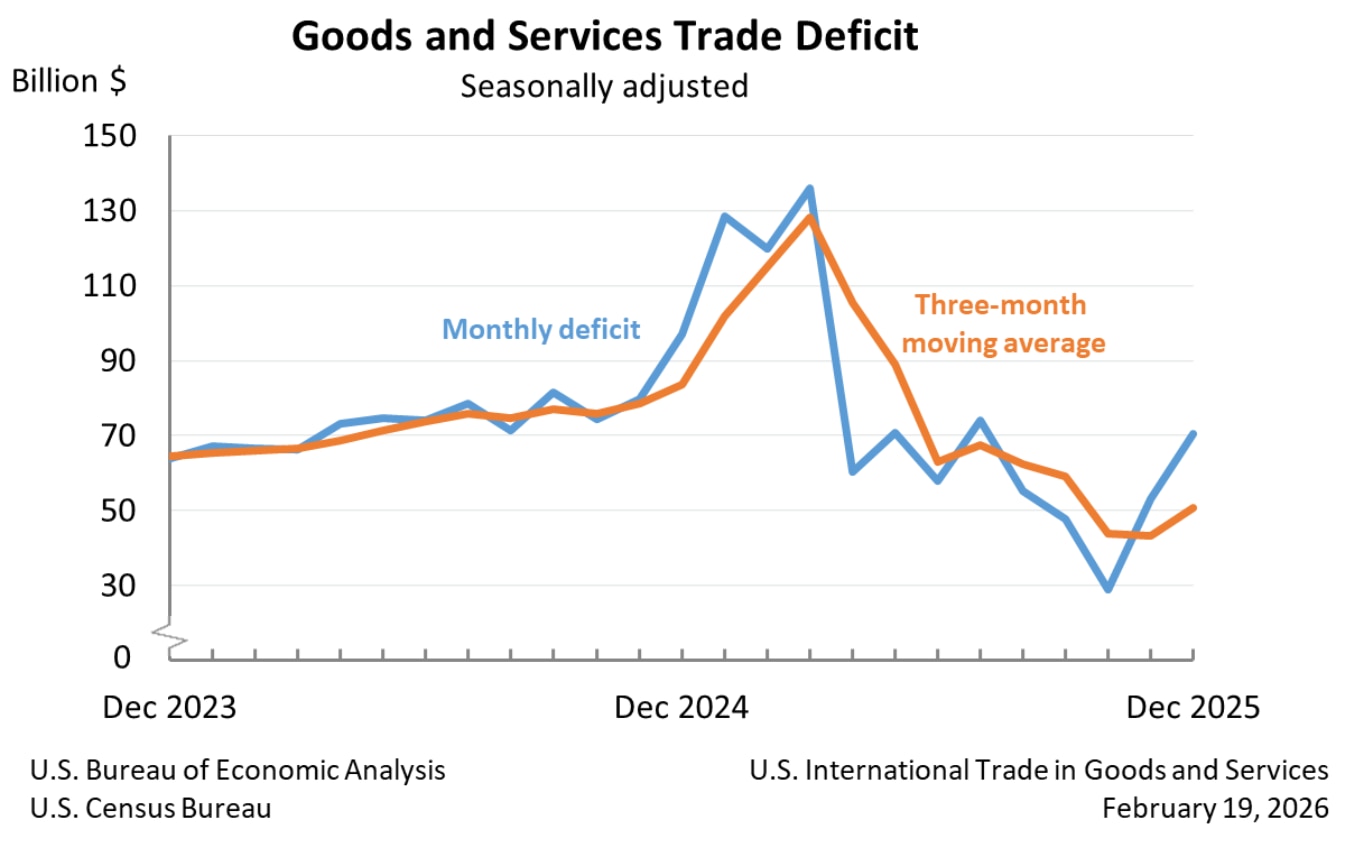
At the same time, the overall trade deficit decreased somewhat due to an increase in services exports.
In December, however, the monthly deficit for goods and services increased by 32.6%, reaching $70.3 billion. During this period, exports decreased, while imports continued to grow despite the imposed tariffs.
In 2025, the volume of goods imported into the U.S. amounted to $3.44 trillion. The largest share was held by capital goods such as computers and telecommunications equipment.
Although the trade deficit with China decreased, an increase in the trade imbalance with other countries offset this effect. For instance, while imports from China decreased by $130.4 billion to $308.4 billion, imports from Taiwan and Vietnam increased by $85.2 billion and $57.3 billion, respectively.
Brief News
In 2025, over 3,000 new trade and industrial policy measures were implemented worldwide.
India and the European Union reached a historic free trade agreement after 20 years of negotiations. The deal covers a region with nearly two billion people.
German Chancellor Friedrich Merz visited Beijing in February and reviewed trade relations with China.
The U.S. and Indonesia finalized a new trade agreement on February 19.
In the UK, the goods trade deficit reached a record level in 2025, amounting to $338 billion.