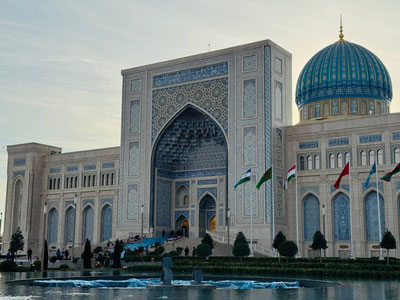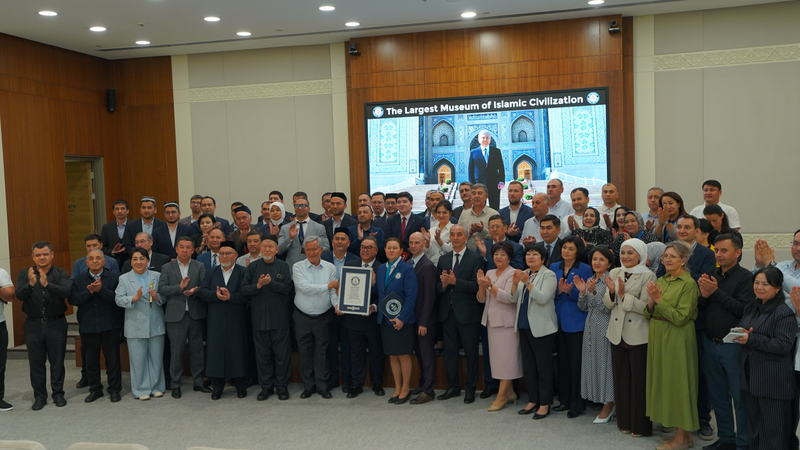
On April 13, 2026, the Center of Islamic Civilization in Uzbekistan was officially awarded the Guinness World Records title for the "Largest museum of Islamic civilisation" in the world.
At the solemn awarding ceremony, the official representative of the Guinness World Records organization — adjudicator Sheyda Subasi — participated and confirmed that the Center fully meets all established international criteria and standards.
The Center of Islamic Civilization in Uzbekistan is a comprehensive scientific-educational and museum complex, which is considered a major strategic megaproject implemented on the initiative of the President of the Republic of Uzbekistan, Shavkat Mirziyoyev. This Center is aimed at harmonizing scientific expertise, rich cultural heritage, and modern technologies in a single space as a unique platform of the "New Uzbekistan".
The project reflects the long-term strategy of the head of state aimed at shaping the country's new humanitarian image, strengthening national identity, and advancing Uzbekistan as one of the world's important centers of Islamic civilization.
Today, the Center has become one of the most visited scientific and cultural destinations in the region, receiving an average of about 5,000 visitors daily. This indicates that it generates great interest among the population and foreign guests.
The Center was originally conceived as a new type of scientific-cultural and educational complex. It presents historical heritage harmoniously combined with modern multimedia technologies. The exposition is built on the principle of "civilizations, personalities, discoveries," consistently covering the development from the most ancient periods of the region to the rise of science and the modern stage.
The Hall of the Holy Quran holds a special place in the Center's structure. It displays one of the oldest manuscripts known as the Uthman Quran, which is included in UNESCO's "Memory of the World" Register. This unique work is not only an invaluable monument of Islamic civilization but also holds great significance as an important spiritual center uniting research and educational activities.
The uniqueness of the Center's concept has made it a pioneering example that combines a museum, scientific research infrastructure, and an educational environment, marking a new stage in world museum practice.
Achieving this record is the result of many months of systematic work, which included confirming the museum's parameters, preparing complete documentation, and undergoing multi-stage verification processes with the participation of independent international experts.
Leading international specialists in the fields of archaeology, numismatics, textiles, and manuscripts participated in forming the museum's collection. This ensures the high scientific and museum standard of the exposition.
The awarding of the Guinness World Records title is not only a recognition of the Center's scale but also a high assessment of the work of hundreds of scientists, specialists, and experts who participated in implementing this project.
Adjudicator Sheyda Subasi highly praised the Center's activities and emphasized the following:
"The Center of Islamic Civilization in Uzbekistan is an outstanding example of harmonizing historical heritage with modern museum technologies. The project's scale, conceptual integrity, and level of implementation fully meet the criteria of Guinness World Records. This is not just the largest museum — it is a modern platform for cultural dialogue and transmitting knowledge to future generations."
This record once again confirms that Uzbekistan is one of the important historical centers of Islamic science, culture, and education. At the same time, it strengthens the country's influence as a modern international arena based on the principles of civilizational dialogue, tolerance, and cultural diversity.
Obtaining the Guinness World Records status solidifies the Center's position as the largest such museum in the world and transforms it into one of the leading international platforms for studying, preserving, and popularizing intellectual heritage.
In the future, the Center of Islamic Civilization in Uzbekistan will further develop as an international scientific and cultural arena, uniting scientists and specialists from various countries of the world, and will serve as an important driver in globally advancing the humanitarian initiatives of the "New Uzbekistan".