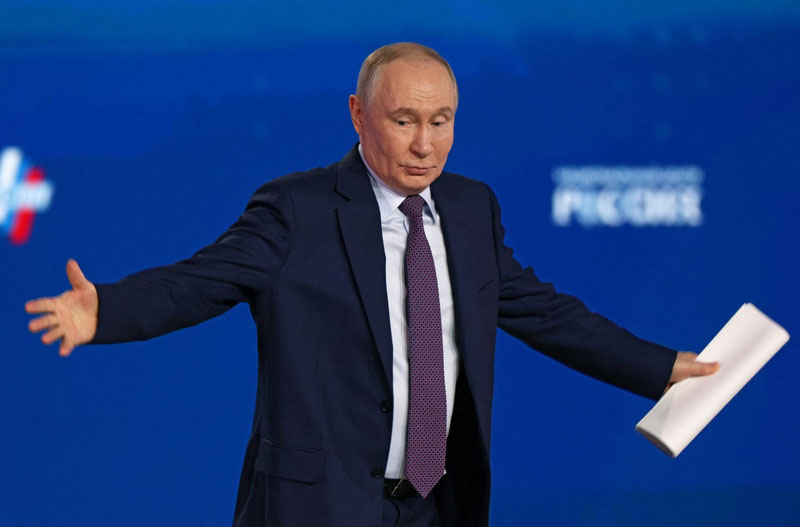
Russian President Vladimir Putin admitted that the fuel shortage in the country has not yet been resolved. He made this statement on June 28 during an unscheduled meeting held at the Kremlin.
According to Putin, despite oil refineries operating at maximum capacity and previously accumulated fuel reserves being directed to the domestic market, the population and business entities continue to face difficulties in purchasing gasoline.
"Problems persist both for car owners and for businesses. Unfortunately, queues have appeared at some gas stations, and it is not always possible to find the required grade of gasoline. We also fully understand the difficulties faced by agricultural producers and farms during the summer season," Putin said.
He emphasized that in order to mitigate the fuel crisis, which has affected almost all regions of the country, the export of gasoline and aviation kerosene has been temporarily banned. Additionally, along with large refineries, small and medium-capacity enterprises have also been brought to full operation. The issue of temporarily suspending diesel fuel exports is currently under discussion.
"Previously accumulated fuel volumes have been released to the domestic market," Putin said.
He reported that the country's gasoline reserves currently stand at 1.7 million tons. According to Reuters calculations, this volume covers approximately 15 days of consumption during the summer months or is enough to compensate for the daily observed gasoline shortage for up to two months.
Putin stressed that the production volume of main fuel types in July should be higher than in June and noted that systemic, rather than short-term, measures are required to stabilize the market.
According to Reuters, Russia is already importing 100,000–150,000 tons of gasoline per month from Belarus. Negotiations are also underway with Kazakhstan regarding fuel deliveries. However, that country effectively has only one oil refinery capable of supplying gasoline to the Russian market.
Economist Kirill Rodionov believes that China and India, which purchase large volumes of Russian oil, could become major fuel suppliers to Russia in the future. However, fuel imported from long distances will be significantly more expensive than domestic products.
At the same time, the Russian government plans to subsidize gasoline imports by allocating budget compensation to oil companies under the damping mechanism. However, this mechanism does not guarantee that imported fuel will be sold at normal prices on the domestic market.
According to Reuters estimates, fuel production in Russia in June decreased by 25 percent compared to the same period last year and currently lags behind domestic consumption by approximately 20 percent.
The only major oil refinery that has not been attacked in the past two months and continues to operate at full capacity is the Omsk Oil Refinery, with an annual capacity of 22 million tons.