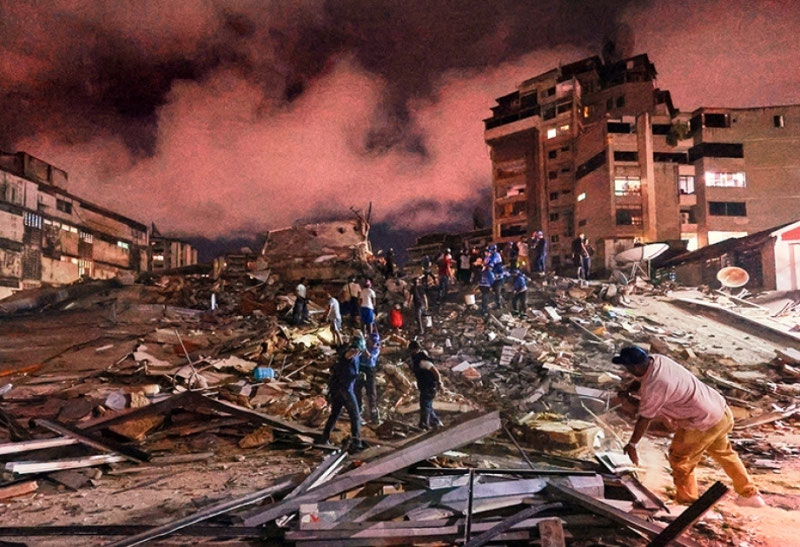
The reddening of the sky after the earthquake in Venezuela sparked widespread discussion on social media. Although some users attempted to link this event to impending natural disasters, experts provided a scientific explanation for the phenomenon.
According to reports, the unusual sight was not caused by new geological processes, but rather by dust and fine solid particles in the atmosphere. As these particles scatter sunlight, the sky appeared reddish in color.
According to the television channel, this phenomenon is scientifically known as "Rayleigh scattering." It becomes more pronounced when the concentration of particles in the air is high, especially when an earthquake coincides with strong winds or dusty air.
It is noted that such sights are often interpreted as omens of new earthquakes or other extraordinary events. However, scientists do not scientifically confirm such views. They emphasize that this is a natural optical reaction of the atmosphere to solid particles in the air.
At the same time, the television channel also mentioned another rare natural phenomenon known as "earthquake lights." Experts explain that such luminous flashes are associated with the generation of electric charges when quartz-containing rocks in the Earth's crust fracture and rub against each other.
This process can, in some cases, produce brief flashes of light in the sky.