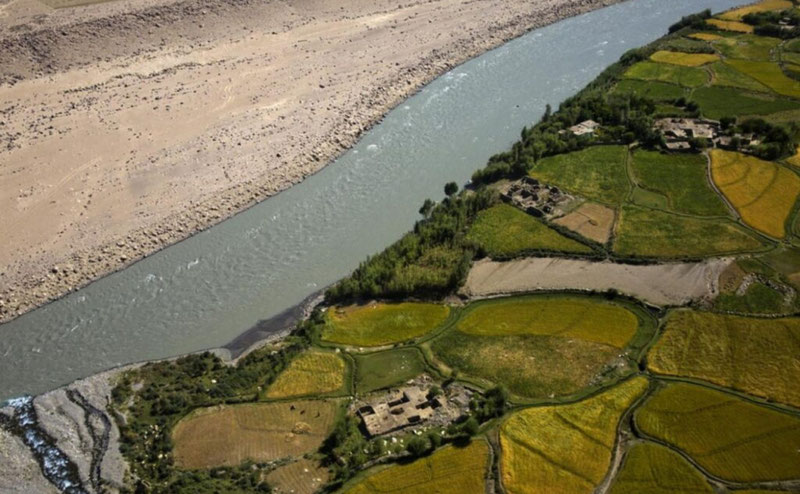
According to scientists, the main reason for this is not climate change, but factors related to human activity.
This is discussed in a scientific study published in the journal ScienceDirect.
The authors of the study note that the main factors contributing to the decrease in the Amu Darya's flow were an increase in the volume of water abstraction from the river, the expansion of irrigated land areas, and the construction of canals, reservoirs, pumping stations, and other structures that alter the natural movement of water.
It is reported that the main water reserves of the Amu Darya are formed in the upper mountainous regions from snow and glaciers. However, the large volume of water taken for agricultural needs in the middle and lower reaches has had a serious impact on the river's flow.
The study emphasizes that during the observation period, air temperature increased by 0.51–0.83 degrees, while precipitation increased by 6–13 percent. According to the scientists' calculations, climate change could have increased river flow by 14–20 percent. However, human activity completely offset this effect and, on the contrary, caused a sharp reduction in water flow.
According to calculations, the impact of human activity in the middle and lower reaches of the Amu Darya is estimated at 114–120 percent. In the upper reaches, the amount of water decreased by 22 percent.
The greatest decrease was observed in the lower reaches of the Amu Darya. In particular, in the Kyzyljar area, water flow decreased by 77 percent compared to 1931–1950. In the Kerki area of Turkmenistan, this figure was 22 percent.
The authors of the study emphasized that in the long term, the reduction of glaciers could further negatively impact the Amu Darya's water reserves.
The study also notes that approximately 92 percent of water consumption in the Amu Darya basin is accounted for by agriculture. In particular, the sharp expansion of irrigated land areas between 1950 and 1990 significantly increased the volume of river water usage.