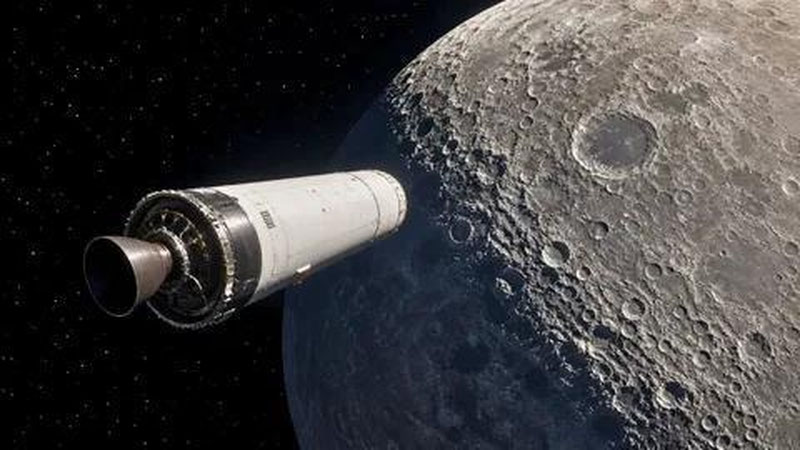
The rocket fragment belonging to the US company SpaceX is expected to hit the lunar surface at high speed today, August 5. This was reported by the Reuters agency.
The discussion is about the second stage of the Falcon 9 rocket that carried Firefly Aerospace's lunar lander into space in January 2025. Usually, such rocket parts burn up in Earth's atmosphere after completing their function or are dropped into a predetermined area of the Pacific Ocean. But because this mission was directed to the Moon, more energy was expended on the rocket, and its second stage remained in space.
According to reports, the rocket part, weighing about 4 tons, will hit the lunar surface at approximately 8,690 kilometers per hour at 02:35 Eastern American time (06:35 GMT).
According to SpaceX, the collision was not planned. The rocket fragment is expected to land in the Einstein crater, located on the western side of the Moon, which is not well visible from Earth.
As a result of the collision, dust may rise on the lunar surface. Scientists say there is a possibility that it will be illuminated by sunlight. However, it is almost impossible to observe this event from Earth with the naked eye.
Astronomers determined that the rocket fragment entered lunar orbit at the beginning of this year. According to Julianna Scheiman, director of NASA science programs and the Dragon project at SpaceX, the rocket part veered toward the Moon due to solar activity and the gravitational pull of various celestial bodies.
The developer of astronomical programs, Bill Gray, noted that this event does not pose a danger to Earth, but that it is necessary to take a more serious approach to the issue of monitoring and disposing of space debris.
This is not the first time space debris has hit the Moon. In 2022, a part of a Chinese launch vehicle crashed onto the lunar surface. Before that, in 2009, NASA deliberately directed a rocket stage at the Moon's surface to study its composition.
In addition, in recent years, several missions aimed at a soft landing on the Moon have also ended in failure. In particular, Russia's "Luna–25" spacecraft in 2023, India's "Chandrayaan–2" and Israel's "Beresheet" spacecraft made hard landings on the lunar surface in 2019 and failed.