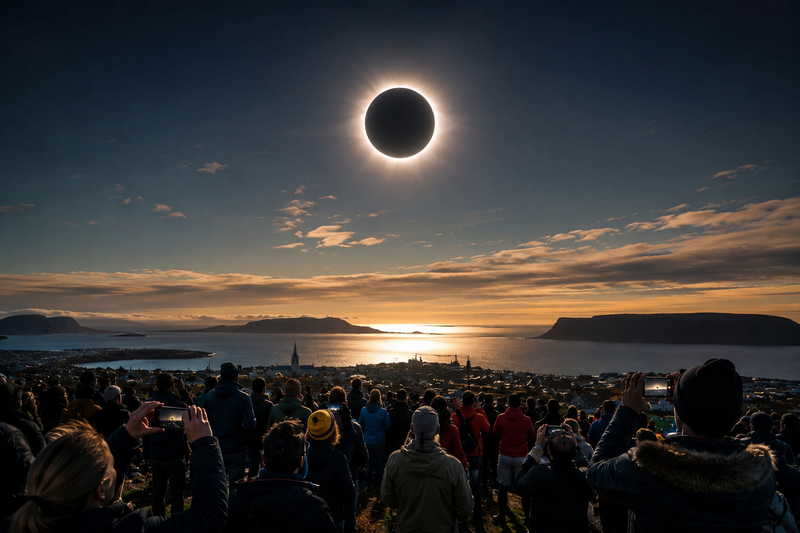
Today, on August 12, a total solar eclipse is being observed in the continental part of Western Europe for the first time in 27 years. This is the first total solar eclipse in the region since 1999.
The rare astronomical phenomenon occurs as a result of the Moon completely blocking the Sun. The path of totality begins in the northern Siberian regions, passes through the Arctic Ocean and the eastern part of Greenland, and reaches the western part of Iceland and the north of Spain. The path of the eclipse also briefly touches the northeastern part of Portugal.
Iceland was one of the most convenient points for observing the total eclipse. In Reykjavik, the capital of the country, the total solar eclipse was observed at 17:48 local time.
In the cities of A Coruña and Bilbao in northern Spain, the total eclipse began shortly before sunset, at approximately 20:28. In Madrid and Barcelona, only part of the Sun was blocked by the Moon.
During a total solar eclipse, the Moon completely covers the disk of the Sun. As a result, darkness falls briefly during the day, the air temperature drops, and in some areas stars can be seen.
In much of Europe, however, the eclipse is observed partially. In Great Britain, Ireland, France, and Italy, the Moon blocks a significant portion of the Sun. In some parts of North Africa, it was also possible to observe this phenomenon partially.
Experts recommend not observing a solar eclipse without special protective glasses. Looking at the Sun with the naked eye can seriously damage eyesight.
It is worth noting that Spain will witness the rare astronomical phenomenon two more times in the coming years. On August 2, 2027, the next total solar eclipse will pass across the country's territory. On January 26, 2028, an annular solar eclipse will be observed in Spain.
As for Western Europe, one will have to wait quite a long time to see the next total solar eclipse.