India introduced six new ideas, like sharing traditional knowledge, helping with skills in Africa, creating a health response team, fighting the link between drugs and terrorism, managing important minerals better, and sharing satellite data openly. These ideas made the summit focus on future growth and development. India also promoted key topics from its 2023 leadership, including building digital systems for everyone, supporting women in development, making supply chains strong, and focusing more on issues that matter to the Global South, such as climate funding, debt relief, and health care systems.
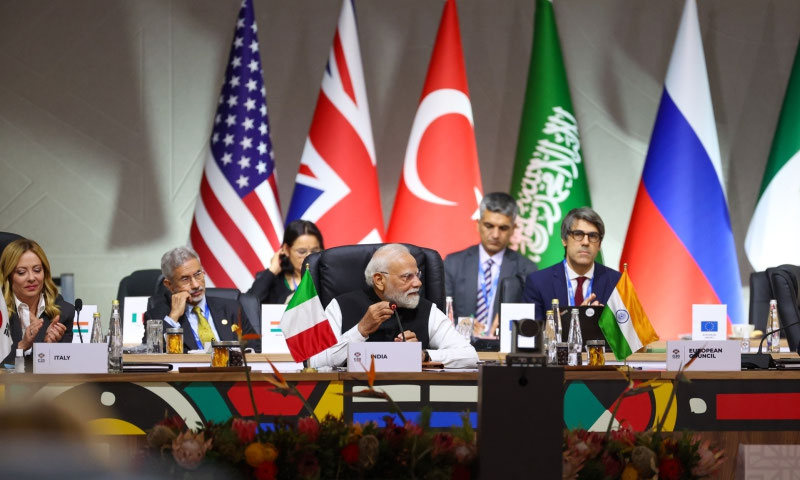
In this light, the G20 Summit 2025 in Johannesburg highlighted India’s growing influence as a global leader, especially representing the interests of developing countries and the Global South. India’s diplomatic approach positioned it as a bridge between the West and emerging economies, bolstering its standing as a “Friend of the World” and strengthening ties through multilateral partnerships.
One of the most exciting developments has been the announcement of the ACITI Partnership. It is a new trilateral cooperation agreement between India, Australia, and Canada which focuses on working together in technology and innovation, especially in important areas like critical technologies, clean energy, artificial intelligence (AI), and supply chains for critical minerals. The partnership aims to build a more secure, sustainable, and resilient technological ecosystem while supporting development goals like net-zero emissions and diversified supply chains. India gets raw critical minerals from Australia and Canada to process them and expand manufacturing in green energy, electronics, and tech products. This cuts India’s dependence on China, creates more jobs, builds tech skills via AI and clean energy projects that use India’s big talent pool, and makes supply chains stronger for reaching net-zero emissions. For the Global South, the ACITI Partnership offers a model where countries like India lead in tech processing and innovation. It helps other developing nations create secure supply chains, use AI for better health, finance, and climate action without relying on major powers, and spreads diversified minerals plus green tech. This reduces debt and development problems by enabling fairer global trade.
But, that’s not all when it comes to India’s contribution to the south-south cooperation at the 2025 G20 summit. There were other initiatives that aimed at capacity building and economic development within the Global South. One major initiative was the G20-Africa Skills Multiplier Initiative. It uses a “train-the-trainers” model where G20 countries train 1 million certified trainers in Africa over the next 10 years. These trainers will then teach skills to millions of young Africans in many sectors, building local skills and long-term growth. For Africa, it creates jobs, empowers youth with useful skills, and boosts the economy by growing homegrown talent instead of relying on outsiders. This leads to stronger local abilities in areas like tech, health, and manufacturing. For the Global South, it again sets an example of sharing skills fairly, helping other developing regions train their people quickly and cheaply. It supports bigger goals like reducing poverty, improving jobs, and sustainable development without heavy debt.
India’s leadership in pushing for sustained climate financing and fair extraction and value addition of critical minerals also addressed equity concerns vital to developing nations. Prime Minister Modi highlighted the declaration’s goal to mobilize at least $1.3 trillion by 2035 for developing countries to achieve Paris Agreement targets, marking a “billions to trillions” shift to address inadequate current flows, with focus on adaptation finance and the Loss and Damage Fund for vulnerable nations. India proposed the Critical Minerals Circularity Initiative to boost recycling, urban mining, and second-life batteries. This cuts the need for new mining, smooths supply chains, and helps clean energy shifts through shared research and standards, mainly for the Global South. Prime Minister Modi also warned about climate change hurting farming and food security. He shared India’s examples like the world’s biggest food security program, health insurance, and crop insurance as ways for all countries to work together.
Moreover, India’s advocacy for digital public infrastructure recognizes the transformative potential of technology for financial inclusion among the Global South. India strengthened bilateral ties on DPI, such as with South Africa, to expand tech-enabled growth, youth skills, and AI industries, and supported the G20 Troika’s (India, Brazil, South Africa) joint communiqué on DPI, AI, and data governance. This advocacy promotes equitable digital access, helping developing nations leapfrog in development without heavy infrastructure costs.
India’s contribution to counter-terrorism efforts at the G20 also reflected south-south cooperation by targeting narcotics trafficking and terror financing networks. This focus on security complements its broader diplomatic effort to strengthen institutional cooperation and technological innovation among developing countries. Despite complex global geopolitical tensions and limited consensus on conflict resolution at the summit, India’s role in shaping new institutional architectures demonstrates its capacity to champion the collective interests of the Global South on the world stage.
Now more than ever before the Global South needs India’s leadership because the world is divided by big power rivalries like US-China tensions, unfair trade rules, and climate crises that hit poor countries hardest, and India offers a trusted voice for fair reforms without threats or debt traps. India, most importantly, pushes for Global South wins. With its fast economy, and non-aligned diplomacy in summits, India represents global seats for developing nations.