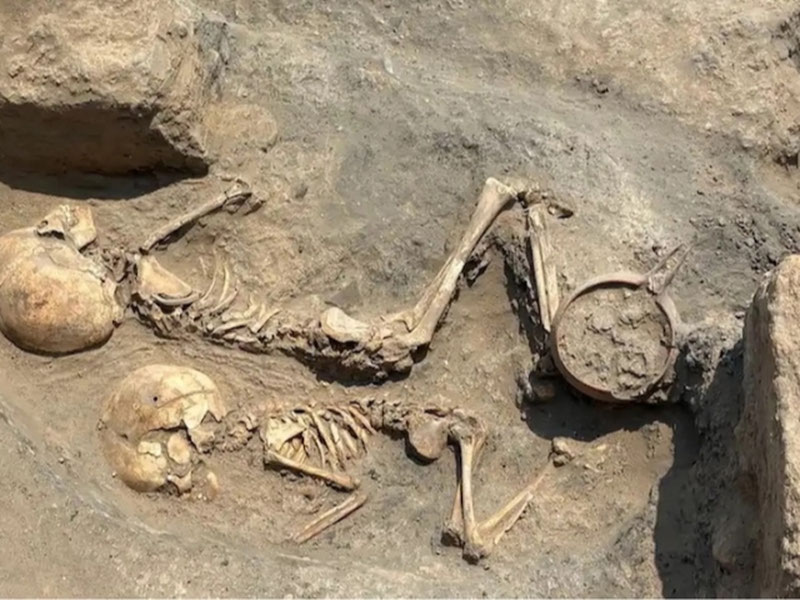
In the territory of Uzbekistan, traces of trepanation — i.e., the surgical opening of the skull — were found on the skull of a child who lived approximately 4,000 years ago, belonging to the Bronze Age. This was reported in an article published in Turkey's journal "Arkeofili".
It is noted that the skeleton of a child who died at about 5 years of age was found during archaeological excavations carried out in recent months. The remains of another child who died at around 3 years of age were also found in the same grave.
Experts emphasize that traces of trepanation performed with stone or bone tools are clearly visible on the skull of the 5-year-old child. According to scientific assumptions, such a procedure might have been used in ancient times to treat epilepsy, migraines, or mental illnesses.
The discovery was made in southern Uzbekistan, near the border with Afghanistan, during an expedition conducted in collaboration between Italian and Uzbek archaeologists.
The excavations were carried out in the area of the Bronze Age settlement of Jarkutan, which scientists date to the end of the 3rd millennium BC. Jarkutan was one of the important urban centers of the Oxus civilization (Bactria–Margiana Archaeological Complex) at that time.
The researchers noted that this civilization developed along major rivers and oases, had strong agriculture and a rich material culture. Its decline was likely linked to possible climate changes and changes in river flows.
Italian archaeologist Enrico Ascalone commented on the find: "Jarkutan continues to amaze us. The fact that such a complex surgical procedure was performed on a child in Central Asia 4,000 years ago is a remarkable case."
Scientists note that this discovery also raises a number of questions: who performed the operation, what medical knowledge was applied, and why this particular child was chosen — these issues will be studied in further research.